
JHAP TAL
Lesson 4
Teaching Artist: Mir Naqibul Islam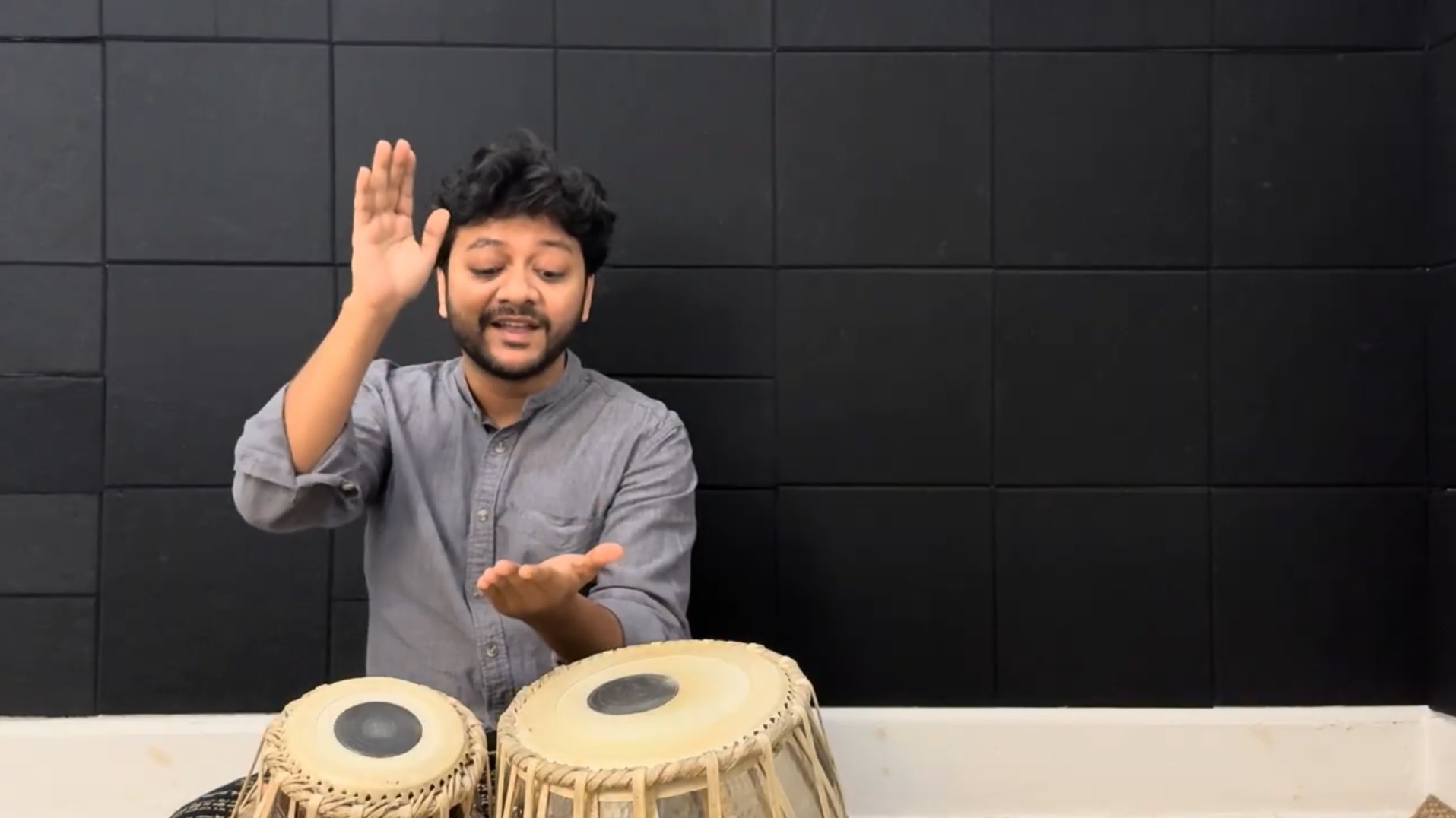
SUMMARY
This is the fourth lesson of the South Asian Rhythm & Grooves unit. Students will be introduced to the ten-beat groove, jhap tal. They will learn how to recite the groove and clap along with the rhythm. Students will then perform together as a group.
OBJECTIVE
Summarize important information about the culture and dance styles of South Asia.
Describe the rhythmic structure and characteristics of jhap tal by listening to examples in this groove.
Demonstrate and apply hand gestures for keeping time.
Recite bols in a steady rhythm: “Dhi – Na – Dhi – Dhi – Na – | Ti – Na – Dhi – Dhi – Na.”
Perform the jhap tal groove using counting patterns and tabla bols (tabla words).
MATERIALS
Body percussion
Adaptive instrument options: feet, tongue clicking, harmonica, gripping aids for holding mallets or sticks
EXPLORE
Display the Google Slides: Jhap Tal. Show students the “gallery” of South Asian dance styles like Kathak, Bharatanatyam, Bhangra, and Garba.
Ask students: Which dances look energetic? What do you notice about the hand movements? Which dance is one you would like to try?
Introduce students to these songs that are based on jhap tal. Allow students to react to the music. Ask: How do the two songs feel different? What do you hear that makes them feel that way? Which instruments do you recognize?
Play Jhap Tal Watch & Learn. After watching the instructional video with Mir, begin by leading the class in counting the ten-beat jhap rhythm aloud together:
“One, two, three, four, five, six, seven, eight, nine, ten,” keeping a steady medium tempo (around 120 bpm) with a light, even groove that reflects the 10-beat jhap cycle.
Repeat the count in groups of four or eight cycles, emphasizing the accents on beats 1 and 6 to highlight the jhap tal structure.
Introduce the hand gestures for keeping time: Practice these gestures together while continuing to count aloud:
Beat 1: Clap your right hand onto your left palm.
Beat 2: Touch right pinky to left palm.
Beat 3: Clap your right hand onto your left palm.
Beat 4: Touch right pinky to left palm.
Beat 5: Touch right ring finger to left palm.
Beat 6: Wave your right hand in the air.
Beat 7: Touch right pinky to left palm.
Beat 8: Clap your right hand onto your left palm.
Beat 9: Touch right pinky to left palm.
Beat 10: Touch right ring finger to left palm.
Divide the class into two groups. Have one group keep time using numbers (1–10) and the other group mirror the pattern using hand gestures. Then switch roles so everyone practices both counting and physical timing.
Once students are confident, replace the numbers with *bols — reciting:
“Dhi – Na – Dhi – Dhi – Na – | Ti – Na – Dhi – Dhi – Na”
*Bols are special sounds or syllables used in South Asian music to help remember and say rhythms out loud. Musicians use them like a musical language to practice and understand patterns of beats.
Repeat the cycle several times as a group, then play a short children’s song in jhap tal and encourage students to clap or gesture along with the rhythm.
Have students practice independently or as a group using the Jhap Tal Practice video and maintain a steady ten-beat cycle. Clap or use hand gestures in time saying the bols, “Dhi – Na – Dhi – Dhi – Na – | Ti – Na – Dhi – Dhi – Na.”
LEARN
PERFORM+SHARE
Invite a few individual students to demonstrate the full jhap cycle—first counting “1, 2, 3, 4, 5, 6, 7, 8, 9, 10” twice; then repeating it with hand gestures; and finally reciting the bols “Dhi Na Dhi Dhi Na | Ti Na Dhi Dhi Na.”
After the individual demonstrations, invite the whole class to join in. Everyone performs together using claps, hand gestures, and bols of jhap tal. Share a video, picture, or artifact of the performance on the S’Cool Sounds Padlet.
Tell students in the next lesson they will introduced to the sixteen-beat groove, tin tal.